







Sacred Heart Cathedral, Bendigo: Difference between revisions
123.3.21.113 (talk) No edit summary |
Anglicanus (talk | contribs) Undid revision 657146771 by 123.3.21.113 (talk) possible vandalism |
||
| Line 27: | Line 27: | ||
==Description== |
==Description== |
||
Sacred Heart Cathedral is one of Australia's largest churches and the second tallest after [[St Patrick's Cathedral, Melbourne|St Patrick's Cathedral]] in [[Melbourne]].for a provincial city cathedral in Australia and its construction was made possible chiefly through the estate of [[George Henry Backhaus|Henry Backhaus]] a German from [[Paderborn]] and the first Catholic priest on the Bendigo goldfields. Backhaus was very skilled in financial matters and accumulated considerable property - not least through encouraging his gold-mining parishioners to contribute some of their findings to the work of the church. Backhaus left his wealth for the benefit of the church and enabled the cathedral, among other things, |
Sacred Heart Cathedral is one of Australia's largest churches and the second tallest after [[St Patrick's Cathedral, Melbourne|St Patrick's Cathedral]] in [[Melbourne]]. It is an exceptionally large church for a provincial city cathedral in Australia and its construction was made possible chiefly through the estate of [[George Henry Backhaus|Henry Backhaus]] (1811-1882), a German from [[Paderborn]] and the first Catholic priest on the Bendigo goldfields. Backhaus was very skilled in financial matters and accumulated considerable property - not least through encouraging his gold-mining parishioners to contribute some of their findings to the work of the church. Backhaus left his wealth for the benefit of the church and enabled the cathedral, among other things, to be built. |
||
In 1895 Martin Crane, an [[Augustinian]] and the first bishop of the diocese, called for competitive designs for a cathedral from several architects. The winning architect was [[William Tappin]] of the firm Reed, Barnes and Tappin, a firm established by [[Joseph Reed (architect)|Joseph Reed]], one of [[Melbourne|Melbourne's]] most significant architects. It was built in the [[Gothic Revival]] style from sandstone quarried from the [[Geelong]] area.<ref>{{cite book |author=Arneil, Stan |title=Out Where the Dead Men Lie: The Augustinians in Australia 1838{{spaced ndash}}1992 |publisher=Augustinian Press |location=Brookvale, NSW |year=1992 |isbn= |pages= }}</ref> |
In 1895 Martin Crane, an [[Augustinian]] and the first bishop of the diocese, called for competitive designs for a cathedral from several architects. The winning architect was [[William Tappin]] of the firm Reed, Barnes and Tappin, a firm established by [[Joseph Reed (architect)|Joseph Reed]], one of [[Melbourne|Melbourne's]] most significant architects. It was built in the [[Gothic Revival]] style from sandstone quarried from the [[Geelong]] area.<ref>{{cite book |author=Arneil, Stan |title=Out Where the Dead Men Lie: The Augustinians in Australia 1838{{spaced ndash}}1992 |publisher=Augustinian Press |location=Brookvale, NSW |year=1992 |isbn= |pages= }}</ref> |
||
Revision as of 13:54, 19 April 2015
| Sacred Heart Cathedral | |
|---|---|
 Sacred Heart Cathedral | |
| Religion | |
| Affiliation | Roman Catholic |
| Diocese | Diocese of Sandhurst |
| Ecclesiastical or organizational status | Cathedral[1] |
| Year consecrated | 1901 |
| Location | |
| Location | Bendigo, Victoria, Australia |
 Interactive map of Sacred Heart Cathedral | |
| Coordinates | 36°45′36″S 144°16′26″E / 36.760°S 144.274°E |
| Architecture | |
| Architect | William Tappin |
| Style | Gothic Revival |
| Groundbreaking | 1897 |
| Completed | 1977 |
| Specifications | |
| Length | 75.68 metres (248.3 ft) |
| Width | 43.47 metres (142.6 ft) |
| Height (max) | 86.64 metres (284.3 ft) |
| Website | |
| www.sacredheartcathedral.org.au | |
Sacred Heart Cathedral, Bendigo is the cathedral church of the Roman Catholic Diocese of Sandhurst and seat of the Bishop of Sandhurst. The cathedral is located in the provincial city of Bendigo, Victoria, Australia.
Description
Sacred Heart Cathedral is one of Australia's largest churches and the second tallest after St Patrick's Cathedral in Melbourne. It is an exceptionally large church for a provincial city cathedral in Australia and its construction was made possible chiefly through the estate of Henry Backhaus (1811-1882), a German from Paderborn and the first Catholic priest on the Bendigo goldfields. Backhaus was very skilled in financial matters and accumulated considerable property - not least through encouraging his gold-mining parishioners to contribute some of their findings to the work of the church. Backhaus left his wealth for the benefit of the church and enabled the cathedral, among other things, to be built.
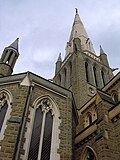
In 1895 Martin Crane, an Augustinian and the first bishop of the diocese, called for competitive designs for a cathedral from several architects. The winning architect was William Tappin of the firm Reed, Barnes and Tappin, a firm established by Joseph Reed, one of Melbourne's most significant architects. It was built in the Gothic Revival style from sandstone quarried from the Geelong area.[2]
The large pipe organ, built by Bishop & Son of London, was installed late in 1905.
After a long interval, work recommenced on the cathedral in 1954 and was completed in 1977. The later works were designed by Bates, Smart and McCutcheon, the successor of Reed, Barnes and Tappin. The spire was of lighter construction than that originally designed, being steel framed and clad with a masonry veneer.
Sacred Heart Cathedral is 75 metres long and has a ceiling height of 24 metres. The main spire is 87 metres high.
Photo gallery
-
 Exterior
 -
 Interior
 -
Before completion in 1977Before completion in 1977


References
- ^ "Sacred Heart Cathedral". GCatholic.org. 15 January 2012. Retrieved 3 February 2012.
- ^ Arneil, Stan (1992). Out Where the Dead Men Lie: The Augustinians in Australia 1838 – 1992. Brookvale, NSW: Augustinian Press.
External links

Catholic cathedrals in Australia by diocese | |
|---|---|
A list of Catholic dioceses in Australia and their cathedrals | |
| Province of Sydney |
|
| Province of Melbourne | |
| Province of Brisbane | |
| Province of Perth | |
| Province of Adelaide | |
| Immediately subject to the Holy See/Patriarch |
|
