







Heiligenhoven Castle
| Heiligenhoven Castle | |
|---|---|
Schloss Heiligenhoven | |
| Lindlar, Oberbergischer Kreis, North Rhine-Westphalia, Germany | |
 Heiligenhoven Castle | |
| Site information | |
| Owner | Landschaftsverbandes Rheinland |
| Open to the public | No |
| Condition | All parts receive |
| Location | |
 | |
| Coordinates | 51°00′50″N 7°21′21″E / 51.0140°N 7.3558°E |
| Height | 226 m |
| Site history | |
| Built | 1273 |
| Built by | Johann van Eyckelinckhoyven |
| In use | Until Management Bergisches Freilichtmuseum Lindlar |
| Materials | Quarrystone |
Heiligenhoven Castle (German: Schloss Heiligenhoven) is a historic building situated in the municipality of Lindlar, Oberbergischer Kreis, North Rhine-Westphalia, Germany.
History
Heiligenhoven is a former castle. It is mentioned for the first time in 1363. The layout, with an outer bailey and a manor house surrounded with water stems from between 1758 and 1760. The name of the castle is derived from an old hall name, Inghoven, the house on the slope.
The property was mentioned for the first time in a document in 1425. Heiligenhoven was in the possession of Rittmeister Johann van Eyckelinckhoyven, called de Wrede. In 1461, Aillff of Eyckelynckhoyven, called de Wrede acquired the property Ober-Heiligenhoven. It changed hands again in 1573, going to the family of Wilhelm von Steinrod. It remained in the possession of this family until 1663, when it was transferred on 2 June 1663 to a cousin of the family, Adolf Schenck von Niddegen. He died in 1666 of the plague, and his gravestone is embedded in the masonry of the St. Severinus Parish Church in Lindlar.
In 1748, Johann Joseph Reichsritter von Brück, Schultheiß of the office Steinbach, acquired the property. He oversaw the building of a new manor house. In the 19th century, the Westphalian noble family of Fürstenberg bought the property. After 1925, Heiligenhoven was inhabited by Fernandine Theresia Freiin von Fürstenberg, who, as a result of the generally bad economic situation, was forced to sell single properties of the former feudal estate.
The castle was bought in 1928 by Kreis Wipperfürth, who had emergency work carried out to reduce unemployment. Large areas of forest were cleared, on which the farms Eibachhof, Krähenhof, Tannenhof, Wiedfeld, Nußbüchel, Dutztal, Im alten Hau, Kesselberg and Weiersbachhof were created. During the Nazi era, the castle served as a camp for the Reich Labour Service. Afterwards, until 1940, the land served as a lodging. From 11 July 1943 to 14 April 1945, the Cologne military district commands were accommodated in the castle.
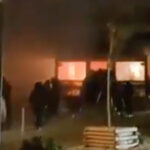
In 1956, the castle was sold to the Adam Stegerwald endowment which converted it into a recreational site. In 1973, the manor house burnt down and was fully rebuilt shortly thereafter in a neobaroque style. The castle was property of the Landscape Association of Rhineland, housed the administration of the LVR-Freilichtmuseum Lindlar, and could be rented for seminars and conferences.[1] In the outer bailey, which is a listed building, there is a youth hostel which allows a stay of several days to school classes. In 2015, the property was sold to the Dutch company Dommeldal B.V. with the intention to build a facility to treat patients with burn-out.[2] In 2023, it was not yet operational.[3]
Castle park
The publicly accessible grounds of castle Heiligenhoven were created in about 1880 in the style of an English landscape garden. In the scenic park, there is a pond and a variety of very old trees. A footpath (5 minutes) leads to the LVR-Freilichtmuseum Lindlar.
-
 The pond of castle park
 -
 Castle park


References
- ^ "Schloss Heiligenhoven". www.dasbergische.de (in German). Retrieved 2024-02-18.
- ^ "Schloss Heiligenhoven ist verkauft". Oberberg aktuell. 2015-06-25. Retrieved 2024-02-18.
- ^ "Streit um Millionen Mehrkosten: Eröffnung der Lindlarer Burnoutklinik verschiebt sich weiter". Rundschau Online (in German). 2023-03-08. Retrieved 2024-02-18.