






Johnston County, North Carolina
Johnston County, North Carolina | |
|---|---|
 | |
 Seal  Logo | |
 Location within the U.S. state of North Carolina | |
 Interactive map of Johnston County, North Carolina | |
| Coordinates: 35°31′N 78°22′W / 35.51°N 78.37°W | |
| Country |  United States United States |
| State |  North Carolina North Carolina |
| Established | June 28, 1746 |
| Named after | Gabriel Johnston |
| Seat | Smithfield |
| Largest community | Clayton |
| Area | |
• Total | 795.65 sq mi (2,060.7 km2) |
| • Land | 792.02 sq mi (2,051.3 km2) |
| • Water | 3.63 sq mi (9.4 km2) 0.46% |
| Population (2020) | |
• Total | 215,999 |
• Estimate (2024) | 249,794  |
| • Density | 272.72/sq mi (105.30/km2) |
| Time zone | UTC−5 (Eastern) |
| • Summer (DST) | UTC−4 (EDT) |
| ZIP Codes | 27501, 27504, 27520, 27524, 27527, 27529, 27542, 27555, 27557, 27568, 27569, 27576, 27577, 27591, 27592, 27597, 27603, 28334, 28366 |
| Area code | 919, 984 |
| Congressional district | 13th |
| Website | johnstonnc |
Johnston County is a county located in the U.S. state of North Carolina. As of the 2020 census, its population was 215,999.[1] Its county seat is Smithfield.[2] Johnston County is included in the Raleigh-Cary, NC Metropolitan Statistical Area, which is also included in the Raleigh-Durham-Cary, NC Combined Statistical Area, which had an estimated population of 2,368,947 in 2023.[3]
History
Early history
Johnston County and St. Patrick's Parish were established on June 28, 1746, from the upper part of Craven County, North Carolina.[4] The county was named after Gabriel Johnston, governor of North Carolina from 1734 to 1752.[5] On March 1, 1752, part of Granville, Johnston, and Bladen counties were combined to form Orange County and St. Matthew's Parish.[6] On November 23, 1758, Johnston County was divided between the parish of St. Patrick and the parish of St. Stephen, St. Patrick's Parish becoming Dobbs County.[7] On December 5, 1770, parts of Johnston, Cumberland, and Orange counties were combined to form Wake County and St. Margaret's Parish.[8] Finally, on February 13, 1855, parts of Edgecombe, Nash, Johnston, and Wayne counties were combined to form Wilson County.[9] Most colonial settlers in Johnston County were subsistence farmers. A few grew tobacco as a cash crop or raised pigs and cattle, which were sold in Virginia. Smithfield was the westernmost freight port on the Neuse River, and in 1770, the provincial government erected a tobacco warehouse there to store the crop before it was shipped out.[10]
19th century
Eli Whitney's cotton gin was introduced in the county around 1804, leading cotton to become the area's leading cash crop. Production for sale at markets remained low before the 1850s due to poor transportation links with other parts of the state. In 1856, the North Carolina Railroad was completed, connecting Johnston County with major urban areas. As result, farming for sale increased, lumber and turpentine industries developed, and the towns of Princeton, Pine Level, Selma, and Clayton were eventually created. About 1,500 Johnstonian men fought in the American Civil War, of whom about a third died. Lingering political tensions and the emancipation of slaves created social and economic turmoil. The new state constitution of 1868 created the county's first townships, which were altered up until 1913.[11] In 1886, the "Short-Cut" line of the Wilmington and Weldon Railroad was laid through Johnston, eventually giving rise to the towns of Kenly, Micro, Four Oaks, and Benson.[12] The Panic of 1893 caused cotton prices to sharply decline, leading area farmers to switch to bright leaf tobacco as their primary cash crop. A new tobacco market was established in Smithfield in 1898, and the county's first bank was created.
20th century
Within several years, cotton mills were erected in Smithfield, Clayton, and Selma. During World War I, a brief surge in tobacco and cotton prices brought a boom to the local economy. As a result, the county embarked on a school-construction campaign and consolidated all public schools under a single county system.[13] In the 1920s, the state built the county's first two paved highways, and shortly thereafter, many towns began paving their main streets.[14] While local commerce enjoyed significant success during the decade, area farmers struggled due to drops in tobacco and cotton prices. The Wall Street Crash of 1929 and ensuing Great Depression caused all banks in the county to close.[13] Following the passage of a state bond issue in 1949, most roads in the county and town streets were paved.[15]
Geography
According to the U.S. Census Bureau, the county has a total area of 795.65 square miles (2,060.7 km2), of which 3.63 square miles (9.4 km2) (0.46%) are covered by water.[16]
State and local protected areas
- Bentonville Battlefield State Historic Site
- Clemmons Educational State Forest (part)
- Flower Hill Nature Preserve (part)
- Howell Woods Environmental Learning Center
- Wild Bills Western Town - Shadowhawk
Major water bodies
- Black Creek
- Buckhorn Reservoir
- Buffalo Creek
- Hannahs Creek[17]
- Holts Lake
- Little Creek
- Little River
- Middle Creek
- Mingo Swamp
- Mill Creek[18]
- Moccasin Creek
- Neuse River
- Sassarixa Swamp
- Snipers Creek
- Swift Creek
Adjacent counties
- Wake County – northwest
- Franklin County – north
- Nash County – northeast
- Wilson County – east
- Wayne County – southeast
- Sampson County – south
- Harnett County – southwest
Major highways


Major infrastructure
- Johnston Regional Airport
- Selma Union Depot
Demographics
| Census | Pop. | Note | %± |
|---|---|---|---|
| 1790 | 5,691 | — | |
| 1800 | 6,301 | 10.7% | |
| 1810 | 6,867 | 9.0% | |
| 1820 | 9,607 | 39.9% | |
| 1830 | 10,938 | 13.9% | |
| 1840 | 10,599 | −3.1% | |
| 1850 | 13,726 | 29.5% | |
| 1860 | 15,656 | 14.1% | |
| 1870 | 16,897 | 7.9% | |
| 1880 | 23,461 | 38.8% | |
| 1890 | 27,239 | 16.1% | |
| 1900 | 32,250 | 18.4% | |
| 1910 | 41,401 | 28.4% | |
| 1920 | 48,998 | 18.3% | |
| 1930 | 57,621 | 17.6% | |
| 1940 | 63,798 | 10.7% | |
| 1950 | 65,906 | 3.3% | |
| 1960 | 62,936 | −4.5% | |
| 1970 | 61,737 | −1.9% | |
| 1980 | 70,599 | 14.4% | |
| 1990 | 81,306 | 15.2% | |
| 2000 | 121,965 | 50.0% | |
| 2010 | 168,878 | 38.5% | |
| 2020 | 215,999 | 27.9% | |
| 2024 (est.) | 249,794 | [19] | 15.6% |
| U.S. Decennial Census[20] 1790–1960[21] 1900–1990[22] 1990–2000[23] 2010[24] 2020[1] | |||
2020 census
| Race | Number | Percentage |
|---|---|---|
| White (non-Hispanic) | 136,464 | 63.18% |
| Black or African American (non-Hispanic) | 33,041 | 15.3% |
| Native American | 880 | 0.41% |
| Asian | 1,831 | 0.85% |
| Pacific Islander | 71 | 0.03% |
| Other/multiracial | 9,312 | 4.31% |
| Hispanic or Latino | 34,400 | 15.93% |
As of the 2020 census, the county had a population of 215,999, 79,053 households, and 53,743 families residing in the county.[26]
The median age was 38.0 years. 25.9% of residents were under the age of 18 and 13.9% of residents were 65 years of age or older. For every 100 females there were 95.8 males, and for every 100 females age 18 and over there were 93.0 males age 18 and over.[26]
The racial makeup of the county was 65.9% White, 15.6% Black or African American, 0.8% American Indian and Alaska Native, 0.9% Asian, <0.1% Native Hawaiian and Pacific Islander, 8.4% from some other race, and 8.3% from two or more races. Hispanic or Latino residents of any race comprised 15.9% of the population.[27]
47.0% of residents lived in urban areas, while 53.0% lived in rural areas.[28]
There were 79,053 households in the county, of which 37.3% had children under the age of 18 living in them. Of all households, 54.8% were married-couple households, 14.9% were households with a male householder and no spouse or partner present, and 24.2% were households with a female householder and no spouse or partner present. About 21.7% of all households were made up of individuals and 9.3% had someone living alone who was 65 years of age or older.[26]
There were 84,340 housing units, of which 6.3% were vacant. Among occupied housing units, 73.9% were owner-occupied and 26.1% were renter-occupied. The homeowner vacancy rate was 1.6% and the rental vacancy rate was 6.1%.[26]
2000 census
At the 2000 census,[29] 121,965 people, 46,595 households, and 33,688 families were residing in the county. The population density was 154 people per square mile (59 people/km2). The 50,196 housing units had an average density of 63 units per square mile (24 units/km2). The racial makeup of the county was 78.09% White, 15.65% African American, 0.41% Native American, 0.30% Asian, 0.04% Pacific Islander, 4.53% from other races, and 0.99% from two or more races. About 7.74% of the population were Hispanics or Latinos of any race.
Of the 46,595 households, 35.4% had children under 18 living with them, 57.8% were married couples living together, 10.6% had a female householder with no husband present, and 27.7% were not families. About 23.1% of all households were made up of individuals, and 8.6% had someone living alone who was 65 or older. The average household size was 2.58 and the average family size was 3.02.
In the county, the age distribution was 26.1% under 18, 8.1% from 18 to 24, 34.2% from 25 to 44, 21.7% from 45 to 64, and 9.8% who were 65 or older. The median age was 34 years. For every 100 females, there were 98.7 males. For every 100 females 18 and over, there were 96.3 males.
The median income for a household in the county was $40,872 and for a family was $48,599. Males had a median income of $33,008 versus $25,582 for females. The per capita income for the county was $18,788. About 8.9% of families and 12.8% of the population were below the poverty line, including 16.0% of those under 18 and 19.4% of those 65 or over.
Law and government
The county is governed by the Johnston County Board of Commissioners, a seven-member board, elected to serve four-year terms. The commissioners enact policies such as establishment of the property tax rate, regulation of land use and zoning outside municipal jurisdictions, and adoption of the annual budget. Commissioners generally meet each month.[30]
Current (2024) members of the Johnston County Board of Commissioners are:[31]
- R.S. "Butch" Lawter, Jr., chairman
- Patrick E. Harris, vice chairman
- Richard D. Braswell
- Ted Godwin
- Fred J. Smith, Jr.
- April Stephens
Rick Hester is the county manager.[32]
Johnston County is a member of the regional Triangle J Council of Governments.
In 2011, the Johnston County 911 Communications Center became one of four 911 agencies in the world to hold an Accredited Center of Excellence status from the National Academies of Emergency Dispatch in fire, police, and EMD protocols (giving them a Tri-ACE status). The dispatch has been reaccredited three times with the most recent being in 2017.[33][34]
Politics
For most of the time after the Civil War, Johnston County was a classic Solid South county, going Democratic in all but three elections from 1880 to 1964. From 1968 onward, though, it has turned increasingly Republican, with the only breaks in this tradition being its support for third-party candidate George Wallace in 1968 and for Democrat Jimmy Carter in 1976. Carter's unsuccessful bid for reelection in 1980 is the last time that a Democrat has managed even 40% of the county's vote. Despite this, Kamala Harris's 38.59% of the vote was the highest for a Democrat in 44 years, indicating that the county may be moving Democratic.
In the 2020 North Carolina gubernatorial election, Republican Dan Forest won the county by a 17% margin over Democrat Roy Cooper, but in 2024, Republican Mark Robinson won the county by just 0.1%, consistent with the county's recent leftward shift.
| Year | Republican | Democratic | Third party(ies) | |||
|---|---|---|---|---|---|---|
| № | % | № | % | № | % | |
| 1880 | 1,631 | 44.20% | 2,059 | 55.80% | 0 | 0.00% |
| 1884 | 1,831 | 39.50% | 2,805 | 60.50% | 0 | 0.00% |
| 1888 | 2,129 | 41.52% | 2,992 | 58.35% | 7 | 0.14% |
| 1892 | 1,036 | 21.62% | 3,135 | 65.44% | 620 | 12.94% |
| 1896 | 1,824 | 35.29% | 3,343 | 64.67% | 2 | 0.04% |
| 1900 | 1,997 | 38.64% | 3,154 | 61.03% | 17 | 0.33% |
| 1904 | 1,553 | 37.65% | 2,572 | 62.35% | 0 | 0.00% |
| 1908 | 2,827 | 52.16% | 2,593 | 47.84% | 0 | 0.00% |
| 1912 | 1,335 | 25.80% | 2,757 | 53.28% | 1,083 | 20.93% |
| 1916 | 2,857 | 45.17% | 3,468 | 54.83% | 0 | 0.00% |
| 1920 | 5,588 | 48.10% | 6,030 | 51.90% | 0 | 0.00% |
| 1924 | 4,910 | 51.20% | 4,656 | 48.56% | 23 | 0.24% |
| 1928 | 7,696 | 60.42% | 5,041 | 39.58% | 0 | 0.00% |
| 1932 | 3,887 | 28.77% | 9,574 | 70.86% | 50 | 0.37% |
| 1936 | 4,339 | 27.83% | 11,253 | 72.17% | 0 | 0.00% |
| 1940 | 4,192 | 29.59% | 9,976 | 70.41% | 0 | 0.00% |
| 1944 | 4,423 | 34.81% | 8,282 | 65.19% | 0 | 0.00% |
| 1948 | 3,211 | 24.71% | 9,188 | 70.69% | 598 | 4.60% |
| 1952 | 5,429 | 35.19% | 9,997 | 64.81% | 0 | 0.00% |
| 1956 | 4,893 | 33.18% | 9,852 | 66.82% | 0 | 0.00% |
| 1960 | 6,660 | 40.18% | 9,914 | 59.82% | 0 | 0.00% |
| 1964 | 7,523 | 42.15% | 10,326 | 57.85% | 0 | 0.00% |
| 1968 | 6,764 | 33.05% | 4,492 | 21.95% | 9,212 | 45.01% |
| 1972 | 14,272 | 79.24% | 3,488 | 19.37% | 251 | 1.39% |
| 1976 | 8,511 | 45.08% | 10,301 | 54.56% | 67 | 0.35% |
| 1980 | 10,444 | 51.26% | 9,601 | 47.12% | 331 | 1.62% |
| 1984 | 16,210 | 67.32% | 7,833 | 32.53% | 37 | 0.15% |
| 1988 | 15,563 | 63.97% | 8,717 | 35.83% | 49 | 0.20% |
| 1992 | 15,418 | 48.67% | 11,284 | 35.62% | 4,977 | 15.71% |
| 1996 | 18,704 | 58.23% | 11,175 | 34.79% | 2,240 | 6.97% |
| 2000 | 27,212 | 66.12% | 13,704 | 33.30% | 239 | 0.58% |
| 2004 | 36,903 | 67.89% | 17,266 | 31.76% | 188 | 0.35% |
| 2008 | 43,622 | 61.42% | 26,795 | 37.73% | 600 | 0.84% |
| 2012 | 48,427 | 63.15% | 27,290 | 35.58% | 974 | 1.27% |
| 2016 | 54,372 | 63.29% | 28,362 | 33.01% | 3,175 | 3.70% |
| 2020 | 68,353 | 61.38% | 41,257 | 37.05% | 1,747 | 1.57% |
| 2024 | 74,878 | 60.06% | 48,116 | 38.59% | 1,684 | 1.35% |
Education
Higher education
Johnston County is home to Johnston Community College, a public, two-year, postsecondary college located in Smithfield. The college has off-campus centers throughout Johnston County.[36]
Primary and secondary education
Public K-12 education in all of Johnston County is managed by the Johnston County School District,[37] which has 46 schools and has more than 35,400 students.[38] In addition, three charter schools and five private schools are located in the county.
Libraries
The Johnston County Public Affiliated Library system operates six branches throughout the county. The library system keeps books, periodicals, and audio books and has recently expanded the selection to include downloadable e-books.[39] The Hocutt-Ellington Memorial Library in Clayton left the Johnston County affiliated library system in 2015.[40]
Culture
The Bentonville Battlefield State Historic Site is the largest Civil War battlefield in North Carolina. The Battle of Bentonville was fought in 1865 and was the only Confederate offensive targeted to stop General Sherman's march through the South.
The Tobacco Farm Life Museum in Kenly has been collecting artifacts and showcasing the heritage of the Eastern North Carolina farmer for over 35 years. The site includes a museum and restored farmstead, blacksmith shop, and one-room school house.[41]
The Ava Gardner Museum, located in Smithfield, contains a collection of artifacts such as scripts, movie posters, costumes, and personal belongings of actress Ava Gardner, who was born and raised in Johnston County. The museum holds an annual festival.
The Johnston County Heritage Centers in Smithfield contains county artifacts and genealogical records.[42]
The Johnston County Arts Council promotes arts in the county and its schools.[43] Smithfield is the location of an annual Ava Gardner Festival, which celebrates the life of the actress.[44]
The Meadow community is the location of Meadow Lights, an annual display of Christmas lights.[45]
The Ham and Yam festival highlights two agricultural commodities for which Johnston County is a top producer - pork and sweet potatoes.[46]
Media
Radio and television
Johnston County is located in the Raleigh-Durham radio market, ranked by Nielsen as the 37th-largest in the United States. Johnston County's first radio station, WMPM, 1270 AM, in Smithfield, signed on in 1950.[47] The county is also home to WPYB, 1130 AM in Benson, WHPY, 1590 AM in Clayton, WTSB, 1090 AM in Selma, and WKJO, 102.3 FM in Smithfield.
The county is also part of the larger, 23-county Raleigh-Durham-Fayetteville designated market area—the nation's 24th-largest. WNGT-CD, (virtual channel 34.1) a Class A low-powered TV station licensed to both Smithfield and Selma. The station began frequency sharing with Raleigh's WRAL-TV in November 2020, greatly expanding its coverage. Goldsboro-licensed CBS affiliate WNCN, virtual channel 17/RF channel 8, originally known as WYED-TV, signed on from studios and a transmitter in Clayton in 1988 before moving to Raleigh studios in 1995.
Newspapers
- Clayton News-Star
- Kenly News
- Four Oaks-Benson News in Review
- Princeton News Leader
- The Selma News
- Pine Level News
- Johnstonian News
- The Daily Record
- The Smithfield Herald
- The Cleveland Post
- The Garner-Cleveland Record
- The News and Observer
Communities

Towns
- Archer Lodge
- Benson
- Clayton (largest community)
- Four Oaks
- Kenly
- Micro
- Pine Level
- Princeton
- Selma
- Smithfield (county seat)
- Wilson's Mills
Townships
- Banner
- Bentonville
- Beulah
- Boon Hill
- Brogden
- Clayton
- Cleveland
- Elevation
- Ingrams
- Meadow
- Micro
- O'Neals
- Pine Level
- Pleasant Grove
- Selma
- Smithfield
- Wilders
- Wilson Mills
Unincorporated communities
- Allens Crossroads
- Bagley
- Blackmans Crossroads
- Cleveland
- Emit
- Flowers
- Grabtown
- Hocutts Crossroads
- Jordan
- McGee's Crossroads
- Peacocks Crossroads
- Powhatan
- Spilona
- Stancils Chapel
- West Smithfield
- Willow Springs
See also
- List of counties in North Carolina
- National Register of Historic Places listings in Johnston County, North Carolina
- List of places named after people in the United States
- North Carolina in the American Civil War
References
Citations
- ^ a b "QuickFacts: Johnston County, North Carolina". United States Census Bureau. Retrieved March 21, 2024.
- ^ "Find a County". National Association of Counties. Archived from the original on May 31, 2011. Retrieved June 7, 2011.
- ^ "Metropolitan and Micropolitan Statistical Areas Population Totals: 2020-2023". United States Census Bureau, Population Division. March 14, 2024. Retrieved March 15, 2024.
- ^ Complete Revisal of All the Acts of Assembly, 1773, p. 103.
- ^ Gannett, Henry (1905). The Origin of Certain Place Names in the United States (Report) (2nd ed.). Washington: Government Printing Office. p. 170 – via United States Geological Survey.
- ^ Complete Revisal of All the Acts of Assembly, 1773, p. 146.
- ^ Complete Revisal of All the Acts of Assembly, 1773, p. 223.
- ^ Complete Revisal of All the Acts of Assembly, 1773, pp. 476–478.
- ^ Public Laws of the State of North-Carolina, Passed by the General Assembly, at its Session of 1854–'55: Together with the Comptroller's Statement of Public Revenue and Expenditure. Raleigh: Holden & Wilson. 1855. p. 30. LCCN 83644405 – via Internet Archive.
- ^ Complete Revisal of All the Acts of Assembly, 1773, pp. 466.
- ^ Johnson & Barbour 1997, p. 7.
- ^ Johnson & Barbour 1997, pp. 7–8.
- ^ a b Johnson & Barbour 1997, p. 8.
- ^ Johnson & Barbour 1997, p. 8, 13.
- ^ Johnson & Barbour 1997, p. 13.
- ^ "2020 County Gazetteer Files – North Carolina". United States Census Bureau. August 23, 2022. Retrieved September 9, 2023.
- ^ "Hannah Creek Near Benson, NC - 02088210". waterdata.usgs.gov. Retrieved October 28, 2023.
- ^ "Mill Creek Historical Marker". www.hmdb.org. Retrieved April 30, 2023.
- ^ "County Population Totals and Components of Change: 2020-2024". United States Census Bureau. Retrieved August 21, 2025.
- ^ "U.S. Decennial Census". United States Census Bureau. Retrieved January 17, 2015.
- ^ "Historical Census Browser". University of Virginia Library. Retrieved January 17, 2015.
- ^ Forstall, Richard L., ed. (March 27, 1995). "Population of Counties by Decennial Census: 1900 to 1990". United States Census Bureau. Retrieved January 17, 2015.
- ^ "Census 2000 PHC-T-4. Ranking Tables for Counties: 1990 and 2000" (PDF). United States Census Bureau. April 2, 2001. Archived (PDF) from the original on March 27, 2010. Retrieved January 17, 2015.
- ^ "State & County QuickFacts". United States Census Bureau. Archived from the original on July 13, 2011. Retrieved October 21, 2013.
- ^ "Explore Census Data". data.census.gov. Retrieved December 23, 2021.
- ^ a b c d "2020 Decennial Census Demographic Profile (DP1)". United States Census Bureau. 2021. Retrieved December 26, 2025.
- ^ "2020 Decennial Census Redistricting Data (Public Law 94-171)". United States Census Bureau. 2021. Retrieved December 26, 2025.
- ^ "2020 Decennial Census Demographic and Housing Characteristics (DHC)". United States Census Bureau. 2023. Retrieved December 26, 2025.
- ^ "U.S. Census website". United States Census Bureau. Retrieved January 31, 2008.
- ^ "Scheduled Board Meetings". www.johnstonnc.gov. Retrieved March 16, 2018.
- ^ "Meet the Commissioners". www.johnstonnc.gov. November 30, 2023. Retrieved April 9, 2024.
- ^ Bergquist, Garrett (June 23, 2021). "A tradition of service and leadership". Spectrum News 1. Retrieved July 21, 2023.
- ^ "Johnston 911 Center Re-accredited". JoCo Report. September 22, 2017. Retrieved July 21, 2023.
- ^ Barbour, Jason (March 4, 2015). "Johnston County, NC Successfully Tests Wireless Broadband Technology To Improve 9-1-1 Reliability". www.businesswire.com. Retrieved July 21, 2023.
- ^ Leip, David. "Dave Leip's Atlas of U.S. Presidential Elections". uselectionatlas.org. Retrieved March 16, 2018.
- ^ "Johnston Community College". Archived from the original on September 23, 2019. Retrieved February 4, 2020.
- ^ "2020 CENSUS - SCHOOL DISTRICT REFERENCE MAP: Johnston County, NC" (PDF). U.S. Census Bureau. Retrieved July 18, 2024. - Text list
- ^ "District Profile - Johnston County Schools". Archived from the original on February 2, 2017. Retrieved January 26, 2017.
- ^ "Johnston County Affiliated Libraries". www.jocolib.org. Retrieved March 16, 2018.
- ^ "Clayton Transition Announcement". Mary Duncan Public Library. March 6, 2015. Retrieved March 16, 2018.
- ^ "Home | Tobacco Farm Life Museum, Inc". Tobacco Farm Life Mu. Retrieved September 22, 2022.
- ^ Mickey (January 28, 2022). "Johnston County Heritage Center Spotlighted In New Video". JoCo Report. Retrieved August 1, 2022.
- ^ "Johnston County Arts Council". Archived from the original on February 11, 2008. Retrieved January 13, 2008.
- ^ "Ava Gardner Festival". www.johnstoncountync.org. Retrieved November 6, 2022.
- ^ "Calendar of Events in Smithfield/Johnston County, NC". www.johnstoncountync.org. September 22, 2022. Retrieved September 22, 2022.
- ^ "The annual Ham & Yam Festival is one of the biggest events in Smithfield, NC". www.johnstoncountync.org. Retrieved August 23, 2025.
- ^ "Broadcasting Station License Record". licensing.fcc.gov. September 22, 2022. Archived (PDF) from the original on June 24, 2021. Retrieved September 22, 2022.
Bibliography
- A Complete Revisal of All the Acts of Assembly, of the Province of North-Carolina, Now in Force and Use.: Together With the Titles of All Such Laws as are Obsolete, Expired, or Repealed.: With Marginal Notes and References, and an Exact Table to the Whole. Newbern: James Davis. 1773. OCLC 1042380338 – via Internet Archive.
- Johnson, K. Todd; Barbour, Durwood (1997). Johnston County. Arcadia Publishing. ISBN 9780752408170.
Further reading
- Johnston County, North Carolina, Court Martial Minutes, 1761-1779 (1st ed.). 1983. LCCN 83-244254. Transcribed by Weynette Parks Haun
- Marriages of Johnston County, North Carolina, 1762-1868. Baltimore: Genealogical Publishing Co. 1985. ISBN 0-8063-1120-7. LCCN 85-70012. Compiled by Brent H. Holcomb
- Sanders, W. M. Jr.; Ragsdale, G. Y. (1922). Johnston County: Economic and Social. University of North Carolina. LCCN 39014760. OCLC 6523398 – via The Smithfield Observer.
External links
- Government

- General information
 Geographic data related to Johnston County, North Carolina at OpenStreetMap
 - Johnston County, North Carolina at Ballotpedia
- NCGenWeb Johnston County, genealogy resources for the county
- Works by or about Johnston County, North Carolina at the Internet Archive
Places adjacent to Johnston County, North Carolina | ||||||||||||||||
|---|---|---|---|---|---|---|---|---|---|---|---|---|---|---|---|---|
| ||||||||||||||||


Municipalities and communities of Johnston County, North Carolina, United States | ||
|---|---|---|
| Towns | 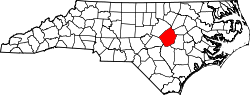 | |
| Unincorporated communities | ||
| Footnotes | ‡This populated place also has portions in an adjacent county or counties | |
Greater Raleigh Metropolitan Region (Raleigh–Cary, MSA; part of the Research Triangle) | ||
|---|---|---|
| Principal cities |  | |
| Other significant cities | ||
| Counties | ||
| Major universities | ||
| Transportation | ||
| Miscellaneous | ||


| International | |
|---|---|
| National | |
| Geographic | |
| Other | |