
Portal:Germany
Welcome to the Germany Portal!
Willkommen im Deutschland-Portal!
.svg)
|

|

| |
Germany (German: Deutschland), officially the Federal Republic of Germany (German: Bundesrepublik Deutschland), is a country in Central and Western Europe, lying between the Baltic Sea and the North Sea to the north with the Alps to the south. It borders Denmark to the north, Poland and the Czech Republic to the east, Austria and Switzerland to the south, France to the southwest, and Luxembourg, Belgium and the Netherlands to the west.
Germany includes 16 constituent states, covers an area of 357,596 square kilometres (138,069 sq mi) and has a largely temperate seasonal climate. With over 83 million inhabitants, it is the second most populous state of Europe after Russia, the most populous state lying entirely in Europe, as well as the most populous member state of the European Union. Germany is a very decentralized country. Its capital and most populous city is Berlin, while Frankfurt serves as its financial capital and has the country's busiest airport.
In 1871, Germany became a nation-state when most of the German states unified into the Prussian-dominated German Empire. After World War I and the Revolution of 1918–19, the Empire was replaced by the parliamentary Weimar Republic. The Nazi seizure of power in 1933 led to World War II and the Holocaust. After the end of World War II in Europe and a period of Allied occupation, two new German states were founded: West Germany, formed from the American, British, and French occupation zones, and East Germany, formed from the western part of the Soviet occupation zone, reduced by the newly established Oder-Neisse line. Following the Revolutions of 1989 that ended communist rule in Central and Eastern Europe, the country was reunified on 3 October 1990.
Germany is a federal parliamentary republic led by a chancellor. It is a great power with a strong economy. As a global leader in several industrial, scientific and technological sectors, it is a major trading nation. The Federal Republic of Germany was a founding member of the European Economic Community in 1957 and the European Union in 1993. Read more...
Selected article
.jpg)
Auschwitz (German: [ˈaʊ̯ʃvɪts]), also known as Oświęcim (Polish: [ɔˈɕfjɛɲ.t͡ɕim]), was a complex of over 40 concentration and extermination camps operated by Nazi Germany in occupied Poland (in a portion annexed into Germany in 1939) during World War II and the Holocaust. It consisted of Auschwitz I, the main camp (Stammlager) in Oświęcim; Auschwitz II-Birkenau, a concentration and extermination camp with gas chambers, Auschwitz III-Monowitz, a labour camp for the chemical conglomerate IG Farben, and dozens of subcamps. The camps became a major site of the Nazis' Final Solution to the Jewish question.
After Germany initiated World War II by invading Poland in September 1939, the Schutzstaffel (SS) converted Auschwitz I, an army barracks, into a prisoner-of-war camp. The initial transport of political detainees to Auschwitz consisted almost solely of Poles (for whom the camp was initially established). For the first two years, the majority of inmates were Polish. In May 1940, German criminals brought to the camp as functionaries established the camp's reputation for sadism. Prisoners were beaten, tortured, and executed for the most trivial of reasons. The first gassings—of Soviet and Polish prisoners—took place in block 11 of Auschwitz I around August 1941. (Full article...)
Selected picture
-
 Wanderer above the Sea of Fog is an 1818 painting by Caspar David Friedrich, a German Romantic. It has been read as a metaphor for the uncertainty of the future.
 -
 Design credit: German New Guinea Company; photographed by the National Numismatic CollectionGerman New Guinea was a German colonial protectorate established in 1884 in the northeastern part of the island of New Guinea and several nearby island groups. The German New Guinea Company was founded in Berlin by Adolph von Hansemann and a syndicate of German bankers for the purpose of colonizing and exploiting the protectorate's resources. This gold coin, worth 20 New Guinean marks, was issued by the German New Guinea Company in 1895, and is now part of the National Numismatic Collection at the Smithsonian Institution.
 -

-
 Photo credit: Chris 73The Cathedral of Magdeburg (known as Magdeburger Dom in German) is the first gothic cathedral in Germany and with a height of 104 m the highest cathedral in Eastern Germany. The current cathedral was constructed over the period of 300 years starting from 1209, and the completion of the steeples took place only in 1520. In 2004 a funding drive for a new organ that was started in 1997 was completed, collecting 2 Million Euro. The new organ has been ordered from a company near Potsdam, constructing a 36 ton instrument with 93 registers and approximately 5000 pipes. The construction is planned to be completed in 2007, and the new organ will hopefully be used for the first time in 2008.
 -
 Photo credit: Daniel SchwenSparrenburg Castle, located in Bielefeld, Germany, as seen from the western lawn. The castle was constructed between 1240 and 1250 by the Counts of Ravensberg. The castle has been rebuilt many times. Although often under siege, it was never stormed. After extensive restoration work, the castle now presents itself as an imposing historic site.
 -
 Map credit: Heinrich BüntingThe Bünting cloverleaf map is a historic mappa mundi drawn by the German theologian and cartographer Heinrich Bünting. The map was published in his book Itinerarium Sacrae Scripturae in 1581. The map depicts the three continents of the Old World, Europe, Africa and Asia, as three leaves forming the shape of a clover, with Jerusalem at the centre. The three continents include captions for some of their countries and illustrations of cities. The clover is surrounded by the ocean, with its surface including illustrations of sea creatures, monsters, and a ship. England and Denmark are represented as two island-shapes above Europe's leaf, while the Americas are shown as a mostly unrevealed shape in the lower left corner, captioned Die Neue Welt (the New World).
 -

Church of Peace in Sanssouci Park Credit: Wolfgang StaudtThe Church of Peace in the Marly Gardens, Sanssouci Park -
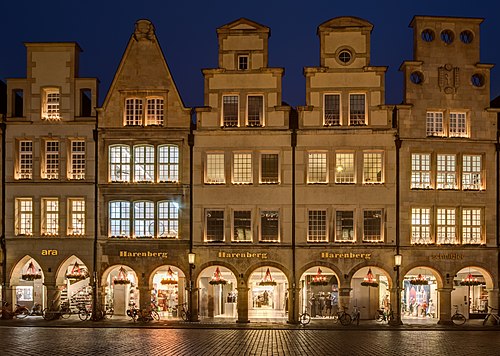
The Prinzipalmarkt in Münster Credit: Dietmar RabichThe Prinzipalmarkt in Münster at night -
 Banknote design credit: Deutsch-Ostafrikanische Bank; photographed by Andrew ShivaThe rupie was the unit of currency of German East Africa between 1890 and 1916. During World War I, the colony was cut off from Germany as a result of a wartime blockade and the colonial government needed to create an emergency issue of banknotes. Paper made from linen or jute was initially used, but because of wartime shortages, the notes were later printed on commercial paper in a variety of colours, wrapping paper, and in one instance, wallpaper. This one-rupie banknote was issued in 1915, and is now part of the National Numismatic Collection at the Smithsonian Institution.
Other denominations:
'"`UNIQ--templatestyles-0000001D-QINU`"' -
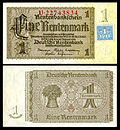 The Rentenmark was a currency introduced on 15 November 1923 in Weimar Germany after the value of the previous currency had been destroyed by hyperinflation.
The banknote shown at left was printed in 1937 or later. It bears an adhesive coupon attached by the East German government in 1948, extending its validity while new East German mark banknotes were being printed. -
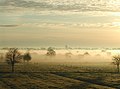 Photo credit: Matthias SüßenMorning fog on the plains of East Frisia, a coastal region in the northwest of the German federal state of Lower Saxony. It connects Western Frisia (in the Netherlands) with the district of Nordfriesland ("Northern Frisia") in Schleswig-Holstein, all of which belong to the historic and geographic Frisia.
 -
 Painting credit: Karl Friedrich SchinkelKarl Friedrich Schinkel (1781–1841) was a Prussian architect and city planner. He was one of the most prominent architects in Germany and designed both Neoclassical and Neo-Gothic buildings, the most famous of which are found in and around Berlin. He was also a painter and a designer of furniture and stage sets.
This oil-on-canvas painting, entitled Castle by the River, was created by Schinkel in 1820. As an artist, his architectural talent shone through, and his buildings and landscapes are carefully drafted and meticulously executed. The painting is in the collection of the Alte Nationalgalerie in Berlin. -
 Photo credit: Daniel SchwenThe interior of the Neue Wache, the central memorial of Germany for victims of war and tyranny. Located in Berlin, the building was originally built as a guardhouse, and has been used as a war memorial since 1931. The statue, Mother with her Dead Son is directly under the oculus, and so is exposed to the rain, snow and cold, symbolising the suffering of civilians during World War II.
 -
-
 Banknote design credit: Danzig Central Finance Department; photographed by Andrew ShivaThe Papiermark is the name given to the German currency from 4 August 1914, when the link between the Goldmark and gold was abandoned. In particular, the name is used for the banknotes issued during the period of hyperinflation in Germany in 1922 and especially 1923. During this period, the Papiermark was also issued by the Free City of Danzig. The last of five series of the Danzig mark was the 1923 inflation issue, which consisted of denominations of 1 million to 10 billion issued from August to October 1923. The Danzig mark was replaced on 22 October 1923 by the Danzig gulden.
This one-million-mark banknote, issued on 8 August 1923, features a portrait of Danzig-born painter and printmaker Daniel Chodowiecki on the obverse and is in the National Numismatic Collection of the Smithsonian Institution's National Museum of American History.
Other denominations:
'"`UNIQ--templatestyles-0000001B-QINU`"' -
 Photograph: Michael KranewitterThomas Müller (b. 1989) is a German professional footballer who has played for Bayern Munich since 2009; he is also the team's vice-captain. A versatile player, Müller plays as a midfielder or forward but has also been deployed in attacking roles such as attacking midfielder, second striker, centre forward and on either wing. He has represented Germany on its national team since 2010.
 -
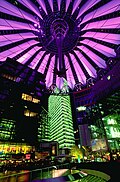 Photo credit: Andreas TilleThe Chicago based, German architect Helmut Jahn is best known for his efficiently designed modernist office blocks. Whilst many of these glass and steel buildings don't stand out from the crowd, some of his most eye-catching projects, such as the Sony Center in Berlin, with its tent-like roof covering the central Forum, border on post-modernism.
 -
-
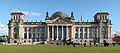 Photo: Matthew FieldThe Reichstag building is a historical edifice in Berlin, Germany, constructed to house the Reichstag, parliament of the German Empire. It was opened in 1894 and housed the Reichstag until 1933, when it was severely damaged in a fire. After German reunification it underwent a reconstruction, completed in 1999, and now houses the modern Bundestag.
 -

Wind beeches on the Schauinsland in the Black Forest Wind beeches on the Schauinsland in the Black ForestCredit: Richard Fabi -
 Painting credit: Adolf MosengelAdolf Mosengel (1837–1885) was a landscape painter from Hamburg, Germany, who built a reputation painting Alpine scenes, later turning to scenes from Westphalia. From 1854 to 1857, he studied at the Kunstakademie Düsseldorf under Hans Gude, and from 1858 to 1859 in Paris, after which he moved to Geneva to study under Alexandre Calame. He spent most of his life working in Hamburg, but travelled in 1879 to the lakes of Northern Italy, where he painted en plein air. This oil-on-canvas painting by Mosengel shows a village in the Bernese Alps.
 -
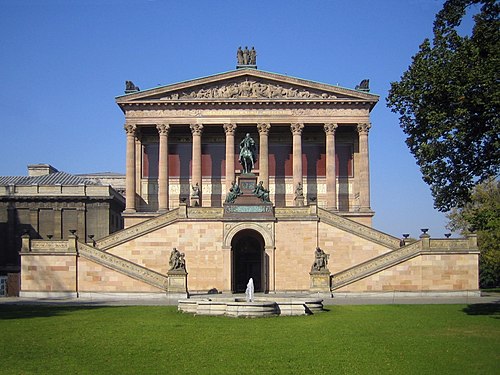
The Alte Nationalgalerie in Berlin Credit: Manfred Brückels


.jpg)


.jpg)
.jpg)


.jpg)


Related portals
- Parent portals
.svg)

- Regional


- History
 Holy Roman Empire (900–1806)
 East Germany (1949–1990)


- Neighbouring countries


Anniversaries for January 15

- 1807 – Birth of zoologist and entomologist Hermann Burmeister
- 1863 – Birth of politician Wilhelm Marx, Chancellor of the Weimar Republic
- 1919 – Revolutionaries Karl Liebknecht and Rosa Luxemburg are murdered by Freikorps soldiers
Did you know...

- ... that Helmut Lachenmann's composition ... zwei Gefühle ... was based on a text about fear and desire by Leonardo da Vinci?
- ... that Bartholomäus Scultetus tried to become the court cartographer of Ivan the Terrible?
- ... that a cartel was formed to purchase papyri for the Berlin Papyrus Collection?
- ... that Lale Andersen, who was popular on both sides of World War II for her version of "Lili Marleen", represented Germany in the Eurovision Song Contest 1961?
- ... that Nazi officer Reinhard Höhn founded a business school after the Second World War?
- ... that recruitment for the French SS Volunteer Assault Brigade was promoted through a Waffen-SS exhibition in Paris that attracted thousands of visitors daily?
- ... that the 2022 German presidential election was held at Paul Löbe House instead of the Reichstag due to the COVID-19 pandemic?
- ... that four US Army soldiers stole $36 million in valuables from a German castle in late 1945?
Selected cuisines, dishes and foods

Beer (German: Bier, pronounced [biːɐ̯] ⓘ) is a major part of German culture. According the Reinheitsgebot (German beer purity law), only water, hops, yeast and malt are permitted as ingredients in its production. Beers not exclusively using barley-malt, such as wheat beer, must be top-fermented.
In 2023, Germany ranked fourth in beer exports and in 2020, Germany ranked third in Europe in terms of per-capita beer consumption, trailing behind the Czech Republic and Austria. (Full article...)Topics
Categories

Things you can do

A list of articles needing cleanup associated with this project is available. See also the tool's wiki page and the index of WikiProjects.
Here are some tasks you can do. Please remove completed tasks from the list.
- Requests: German Archaeological Institute at Rome, Deutsche Familienversicherung, Hermann Bachmann (Journalist), Dietlof von Arnim-Boitzenburg, Rolf von Bargen, Hennes Bender, Eduard Georg von Bethusy-Huc, Rolf Brandt (1886–1953), Jan Philipp Burgard, Rudolf Epp, Lisa Feller, Georg Arbogast von und zu Franckenstein, Georg Gafron, Ferdinand Heribert von Galen, Gundula Gause, Wolfgang von Geldern, Karl-Heinz Hagen, Herbert Helmrich, Nils von der Heyde, Monty Jacobs (1875–1945), Siegfried Kauder, Klimbim Matze Knop, Wolfgang Kryszohn, Claus Larass, Isidor Levy (1852–1929), Richard Lewinsohn (1894-1968), Markus Löning, Tobias Mann, Mathias Müller von Blumencron ,Günther Nonnenmacher, Nord bei Nordwest, Günter von Nordenskjöld, Anke Plättner, Hans Heinrich X. Fürst von Pless, Günter Prinz, Ulrich Reitz, Hans Sauer (inventor), Franz August Schenk von Stauffenberg, Paul Schlesinger (1878-1928), Hajo Schumacher, Der Seewolf (1971), Otto Theodor von Seydewitz, Christoph Sieber (comedian), Dorothea Siems, Werner Sonne, Udo zu Stolberg-Wernigerode, Christoph Strässer, Joseph von Utzschneider, Hedda von Wedel, Jürgen Wieshoff, Hans Wilhelmi, Dietmar Wischmeyer, Doris Wittner (1880-1937), Alexandra Würzbach
- Unreferenced: especially Unreferenced BLPs
- Cleanup: 53541 issues in total as of 2024-03-03
- Translate: Articles needing translation from German Wikipedia
- Stubs: the largest stub category is Category:German history stubs; see also 111 articles in Category:German MEP stubs
- Update: Deutsches Wörterbuch
- Portal maintenance: Update News, Did you know, announcements and the todo list
- Orphans:
Orphaned articles in Germany

- Photo: Take/Add requested photographs
- Help assess the quality of 950 unassessed articles
Associated Wikimedia
The following Wikimedia Foundation sister projects provide more on this subject:
-
 Commons
Free media repository -
 Wikibooks
Free textbooks and manuals -
 Wikidata
Free knowledge base -
 Wikinews
Free-content news -
 Wikiquote
Collection of quotations -
 Wikisource
Free-content library -
 Wikiversity
Free learning tools -
 Wikivoyage
Free travel guide -
 Wiktionary
Dictionary and thesaurus
-

-

-

-

-

-

-

-

-

-

-
 Random portal
 -


