







Crossbuck

A crossbuck is a traffic sign used to indicate a level railway crossing. It is composed of two slats of wood or metal of equal length, fastened together on a pole in a saltire formation (resembling the letter X). Crossbucks are often supplemented by electrical warnings of flashing lights, a bell, and/or a boom barrier that descends to block the road and prevent traffic from crossing the tracks.
Vienna Convention
The Vienna Convention on Road Signs and Signals, a multilateral treaty of the United Nations with the intention of standardizing traffic signs around the world, prescribes several different regulations for the "crossbuck" sign.
The sign should consist of two arms not less than 1.2 metres (3.9 ft) long, crossed in the form of an  . The first model may have a white or yellow background with a thick red or black border. The second model may have a white or yellow background with a thin black border and an inscription, for example, "railroad crossing", "railway crossing", etc. If lateral clearance obstructs the placement of the sign, it may be rotated 90° so that its points are directed vertically. If used at a level crossing with more than one track, a half cross or a supplementary plate stating the number of tracks may be added below.
It specified these models:
-
 A-28a-V1-1
 -
 A-28a-V1-2
 -
 A-28a-V1-1-EA
 -
 28a-V1-2-EA
 -
 A-28c-V1-1


It also specified multi-track models:
-
 A-28b-V1-1
 -
 A-28b-V1-2
 -
 A-28b-V1-1-EA
 -
 A-28b-V1-2-EA
 -
 A-28c-V3-1


Variants around the world


In the United States, the crossbuck carries the words "rail" and "road" on one arm and "crossing" on the other ("rail" and "road" are separated by the "crossing" arm), in black text on a white background. Older variants simply used black and white paint; newer installations use a reflective white material with non-reflective lettering. Some antique U.S. crossbucks were painted in other color schemes, and used glass "cat's eye" reflectors on the letters to make them stand out. Other countries, such as China, also use this layout, but with appropriately localized terms. Often, a supplemental sign below the crossbuck indicates the number of tracks at the crossing. In the 1990s, the state of Ohio experimented with the modified Buckeye Crossbuck, which had a specialized accompanying plate.


In Canada, crossbucks have a red border and no lettering. These were installed in the 1980s shortly after English-French bilingualism was made official, replacing signs of a style similar to those used in the U.S., except the word "railway" was used instead of "railroad" and in certain areas the words "traverse de chemin de fer" were used.
In Mexico, the crossbucks read "cruces ferrocarril", a literal translation of its U.S. counterpart. Older designs read "cuidado con el tren", meaning "beware of the train".
In Argentina, the most common legend is "peligro ferrocarril" ("danger: railroad"). Other crosses also read "cuidado con los trends – pare mire escuche ("beware of the trains – stop, look, listen") for the Ferrocarril Belgrano, "paso a nivel – ferro carril" for the Ferrocarril Mitre and "cuiado con los trenes" ("beware of the trains") for the Ferrocarril Roca.
In parts of Europe, the cross is white with red trimmings or ends, sometimes on a rectangular background; in Finland and Greece the cross is yellow, trimmed with red.
Taiwan uses two crossbucks: a version with a yellow and black cross, and one with the cross in white with a red border. A special symbol in the center indicates an electric railroad crossing, cautioning road users about excessive height cargo that may contact the electric wires.
In Australia, the crossbuck is a St Andrews Cross as in Europe, but uses words and the same color as the American crossbuck. In contrast to the American "railroad crossing", Australian signs say "railway crossing" or "tramway crossing". (Most cases where a tram in its own right-of-way crosses a road do not use a crossbuck and so are regular intersections rather than level crossings.)
Different countries may classify the sign differently. For example, in Australia it is considered a regulatory sign, while in close neighbour New Zealand it is considered a warning sign. Some countries, such as Australia, France, New Zealand, Slovakia and Slovenia may place the crossbuck design on a "target board", while other countries quite often do not. In the United Kingdom, it is only used for crossings with no barriers or signal lights.
Crossbucks of the world
-
![Australia (variant) [1]](https://upload.wikimedia.org/wikipedia/commons/thumb/7/70/Australia_road_sign_R6-25.svg/120px-Australia_road_sign_R6-25.svg.png) Australia (variant) [1]
Australia (variant) [1] -
![Austria [2]](https://upload.wikimedia.org/wikipedia/commons/thumb/d/d7/Gefahrenzeichen_6d_liegend.svg/120px-Gefahrenzeichen_6d_liegend.svg.png) Austria [2]
Austria [2] -
![Austria (vertical) [3]](https://upload.wikimedia.org/wikipedia/commons/thumb/1/13/Gefahrenzeichen_6d.svg/60px-Gefahrenzeichen_6d.svg.png) Austria (vertical) [3]
Austria (vertical) [3] -
![Austria (variant) [4]](https://upload.wikimedia.org/wikipedia/commons/thumb/0/01/Gefahrenzeichen_6d_Tafel.svg/120px-Gefahrenzeichen_6d_Tafel.svg.png) Austria (variant) [4]
Austria (variant) [4] -
![Belgium [5]](https://upload.wikimedia.org/wikipedia/commons/thumb/2/27/Belgian_traffic_sign_A45.svg/120px-Belgian_traffic_sign_A45.svg.png) Belgium [5]
Belgium [5] -
![Brazil [citation needed]](https://upload.wikimedia.org/wikipedia/commons/thumb/a/a3/Brasil_A-41a.svg/120px-Brasil_A-41a.svg.png) Brazil [citation needed]
Brazil [citation needed] -
![Bulgaria [citation needed]](https://upload.wikimedia.org/wikipedia/commons/thumb/7/76/BG_road_sign_%D0%9034.1.svg/120px-BG_road_sign_%D0%9034.1.svg.png) Bulgaria [citation needed]
Bulgaria [citation needed] -
![Canada [6]](https://upload.wikimedia.org/wikipedia/commons/thumb/a/ad/CA-MUTCDC_RA-006.svg/120px-CA-MUTCDC_RA-006.svg.png) Canada [6]
Canada [6] -
![Canada (former) [citation needed]](https://upload.wikimedia.org/wikipedia/commons/thumb/4/40/Canadian_Railway_Crossbuck_%28with_red_backing_board%29.png/120px-Canadian_Railway_Crossbuck_%28with_red_backing_board%29.png) Canada (former) [citation needed]
Canada (former) [citation needed] -
![Canada (former) [citation needed]](https://upload.wikimedia.org/wikipedia/commons/thumb/a/ab/Canadian_Railway_Crossing_Sign_%28English%29_%28old%29.svg/120px-Canadian_Railway_Crossing_Sign_%28English%29_%28old%29.svg.png) Canada (former) [citation needed]
Canada (former) [citation needed] -
![Canada (former) [citation needed]](https://upload.wikimedia.org/wikipedia/commons/thumb/6/67/Canadian_Crossbuck_%28Old%29.svg/120px-Canadian_Crossbuck_%28Old%29.svg.png) Canada (former) [citation needed]
Canada (former) [citation needed] -
![Canada (used in Ontario in the 1950s) [citation needed]](https://upload.wikimedia.org/wikipedia/commons/thumb/5/53/1950%27s_Ontario_warning_traffic_sign%2C_railroad_crossing.svg/120px-1950%27s_Ontario_warning_traffic_sign%2C_railroad_crossing.svg.png) Canada (used in Ontario in the 1950s) [citation needed]
Canada (used in Ontario in the 1950s) [citation needed] -
![Canada (formerly used in Quebec) [citation needed]](https://upload.wikimedia.org/wikipedia/commons/thumb/5/5d/Canadian_Railway_Crossing_Sign_%28French%29_%28old%29.svg/120px-Canadian_Railway_Crossing_Sign_%28French%29_%28old%29.svg.png) Canada (formerly used in Quebec) [citation needed]
Canada (formerly used in Quebec) [citation needed] -
![Central American Integration System Member States [7]](https://upload.wikimedia.org/wikipedia/commons/thumb/d/d4/SIECA_road_sign_R-1-6.svg/120px-SIECA_road_sign_R-1-6.svg.png) Central American Integration System Member States [7]
Central American Integration System Member States [7] -
![Chile [citation needed]](https://upload.wikimedia.org/wikipedia/commons/thumb/9/91/Chile_road_sign_PI-2a.svg/120px-Chile_road_sign_PI-2a.svg.png) Chile [citation needed]
Chile [citation needed] -
![Colombia (former) [citation needed]](https://upload.wikimedia.org/wikipedia/commons/thumb/3/39/Colombia_road_sign_SP-54_%28old%29.svg/120px-Colombia_road_sign_SP-54_%28old%29.svg.png) Colombia (former) [citation needed]
Colombia (former) [citation needed] -
![Denmark [8]](https://upload.wikimedia.org/wikipedia/commons/thumb/e/e8/Denmark_road_sign_A74.1.svg/120px-Denmark_road_sign_A74.1.svg.png) Denmark [8]
Denmark [8] -
![Germany [9]](https://upload.wikimedia.org/wikipedia/commons/thumb/8/8e/Zeichen_201-50_%E2%80%93_Andreaskreuz_-_Dem_Schienenverkehr_Vorrang_gew%C3%A4hren%21_StVO_1992.svg/120px-Zeichen_201-50_%E2%80%93_Andreaskreuz_-_Dem_Schienenverkehr_Vorrang_gew%C3%A4hren%21_StVO_1992.svg.png) Germany [9]
Germany [9] -
![Germany (Level Crossings on Electrified Lines) [citation needed]](https://upload.wikimedia.org/wikipedia/commons/thumb/c/ce/Zeichen_201-51_-_Andreaskreuz_%28stehend%29_mit_Blitzpfeil%2C_StVO_1992.svg/120px-Zeichen_201-51_-_Andreaskreuz_%28stehend%29_mit_Blitzpfeil%2C_StVO_1992.svg.png) Germany (Level Crossings on Electrified Lines) [citation needed]
Germany (Level Crossings on Electrified Lines) [citation needed] -
![Italy [citation needed]](https://upload.wikimedia.org/wikipedia/commons/thumb/9/9a/Italian_traffic_signs_-_croce_di_S.Andrea.svg/120px-Italian_traffic_signs_-_croce_di_S.Andrea.svg.png) Italy [citation needed]
Italy [citation needed] -
![Mexico [10]](https://upload.wikimedia.org/wikipedia/commons/thumb/a/ad/MX_road_sign_SIR-9.svg/120px-MX_road_sign_SIR-9.svg.png) Mexico [10]
Mexico [10] -
![Netherlands [11]](https://upload.wikimedia.org/wikipedia/commons/thumb/d/d7/Nederlands_verkeersbord_J12.svg/60px-Nederlands_verkeersbord_J12.svg.png) Netherlands [11]
Netherlands [11] -
 New Zealand (variant)
 -
 Norway
 -
 Panama
 -
 Peru
Peru -
 Poland
 -
 Romania
 -
 Romania (variant used for railway crossings without gates and lights)
 -
 Singapore
 -
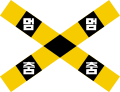 South Korea
 -
 Sweden
 -
 Taiwan
 -
 Thailand
 -
 United States
 -
 United States (inverted variant)
 -
 United States (experimental version used in Ohio for a time)
 -
 United States (variant, former)
 -
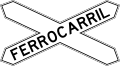 Venezuela
 -
 Vietnam
![Australia (variant) [1]](https://en.wikipedia.org/wiki/File:Australia_road_sign_R6-25.svg)
![Austria [2]](https://en.wikipedia.org/wiki/File:Gefahrenzeichen_6d_liegend.svg)
![Austria (vertical) [3]](https://en.wikipedia.org/wiki/File:Gefahrenzeichen_6d.svg)
![Austria (variant) [4]](https://en.wikipedia.org/wiki/File:Gefahrenzeichen_6d_Tafel.svg)
![Belgium [5]](https://en.wikipedia.org/wiki/File:Belgian_traffic_sign_A45.svg)
![Brazil [citation needed]](https://en.wikipedia.org/wiki/File:Brasil_A-41a.svg)
![Bulgaria [citation needed]](https://en.wikipedia.org/wiki/File:BG_road_sign_%D0%9034.1.svg)
![Canada [6]](https://en.wikipedia.org/wiki/File:CA-MUTCDC_RA-006.svg)
![Canada (former) [citation needed]](https://en.wikipedia.org/wiki/File:Canadian_Railway_Crossbuck_(with_red_backing_board).png)
![Canada (former) [citation needed]](https://en.wikipedia.org/wiki/File:Canadian_Railway_Crossing_Sign_(English)_(old).svg)
![Canada (former) [citation needed]](https://en.wikipedia.org/wiki/File:Canadian_Crossbuck_(Old).svg)
![Canada (used in Ontario in the 1950s) [citation needed]](https://en.wikipedia.org/wiki/File:1950%27s_Ontario_warning_traffic_sign,_railroad_crossing.svg)
![Canada (formerly used in Quebec) [citation needed]](https://en.wikipedia.org/wiki/File:Canadian_Railway_Crossing_Sign_(French)_(old).svg)
![Central American Integration System Member States [7]](https://en.wikipedia.org/wiki/File:SIECA_road_sign_R-1-6.svg)
![Chile [citation needed]](https://en.wikipedia.org/wiki/File:Chile_road_sign_PI-2a.svg)
![Colombia (former) [citation needed]](https://en.wikipedia.org/wiki/File:Colombia_road_sign_SP-54_(old).svg)
![Denmark [8]](https://en.wikipedia.org/wiki/File:Denmark_road_sign_A74.1.svg)
![Germany [9]](https://en.wikipedia.org/wiki/File:Zeichen_201-50_%E2%80%93_Andreaskreuz_-_Dem_Schienenverkehr_Vorrang_gew%C3%A4hren!_StVO_1992.svg)
![Germany (Level Crossings on Electrified Lines) [citation needed]](https://en.wikipedia.org/wiki/File:Zeichen_201-51_-_Andreaskreuz_(stehend)_mit_Blitzpfeil,_StVO_1992.svg)
![Italy [citation needed]](https://en.wikipedia.org/wiki/File:Italian_traffic_signs_-_croce_di_S.Andrea.svg)
![Mexico [10]](https://en.wikipedia.org/wiki/File:MX_road_sign_SIR-9.svg)
![Netherlands [11]](https://en.wikipedia.org/wiki/File:Nederlands_verkeersbord_J12.svg)


.svg)


Multiple tracks
Several countries use a sign to indicate that multiple tracks must be crossed at a level crossing. In Australia, Canada, New Zealand, and the U.S., a sign is mounted beneath the crossbuck (above the warning light assembly, if any) with the number of tracks. Many European countries use multiple crossbucks or additional chevrons ("half-crossbucks") below the first one. Taiwan also uses half-crossbucks below the regular crossbuck.
-
 Argentina
 -
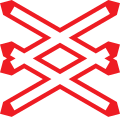 Austria
 -
 Austria
 -
 Austria (variant)
 -
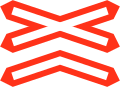 Bangladesh
 -
 Belgium
 -
 Bulgaria
 -
 Cambodia
 -
 China
China -
 Croatia
 -
 Czechia
 -
 Denmark
 -
 Estonia
 -
 Finland
 -
 France
 -
 Greece
 -
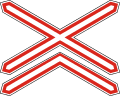 Hungary
 -
 Hungary
 -
 Indonesia
 -
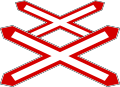 Italy
Italy -
 Latvia
 -
 Luxembourg
 -
 Netherlands
 -
 Norway
 -
 Poland
 -
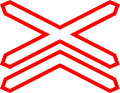 Portugal
 -
 Romania
 -
 Romania (variant used for railway crossings without gates and lights)
 -
 Russia
 -
 Serbia
 -
 Slovakia
 -
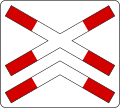 Slovenia
 -
 Slovenia (former)
 -
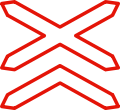 Spain
Spain -
 Sweden
 -
 Switzerland
 -
 Taiwan (variant)
 -
 Taiwan (variant used for electrified railway crossings)
 -
 Tunisia
 -
 Turkey (variant)
 -
 Ukraine
 -
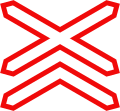 Vietnam


.svg)


.svg)


Advance warning
Several countries include the crossbuck icon on their railway crossing ahead warning signs. In Argentina, railway crossing ahead signs used a common red-bordered triangle defaced with a black steam locomotive icon placed on white background according Vienna Convention as well as the most other countries in the world outside of the Americas.[a]
-
 Vienna Convention; Aa-26b-V1
 -
 Vienna Convention; Ab-26b-V1
 -
 Australia
 -
 Australia (former)
 -
 Australia (side road)
 -
 Australia (variant with warning lights)
 -
 Canada
 -
 Canada (variant for left-skewed crossing)
 -
 Canada (variant for right-skewed crossing)
 -
 Canada (former)
 -
 Iraq
Iraq -
 Panama (variant for railroad crossings without gates but with lights)
 -
 Philippines
 -
 United States
 -
 United States (exempt railroad crossing, the usual requirement for commercial and mass transit vehicles to stop at the crossing regardless of activity on the line need not be obeyed)


.svg)
.svg)


.svg)


Notes
- ^ Used for unprotected railway crossings in most other countries in the world. In Argentina, Germany, Israel — it is used for both protected and unprotected railway crossing ahead signs.
References
- ^ "Australian Road Rules" (PDF). Australasian Parliamentary Counsel's Committee. 120 What is a level crossing. p. 112.
{{cite web}}: CS1 maint: location (link) - ^ "292. Verordnung der Bundesministerin für Verkehr, Innovation und Technologie, mit der die Verordnung über Straßenverkehrszeichen (Straßenverkehrszeichenverordnung 1998 – StVZVO 1998) geändert wird (1. Novelle zur StVZVO 1998)" (in German). Gefahrenzeichen. p. 11.
- ^ "292. Verordnung der Bundesministerin für Verkehr, Innovation und Technologie, mit der die Verordnung über Straßenverkehrszeichen (Straßenverkehrszeichenverordnung 1998 – StVZVO 1998) geändert wird (1. Novelle zur StVZVO 1998)" (in German). Gefahrenzeichen. p. 11.
- ^ "292. Verordnung der Bundesministerin für Verkehr, Innovation und Technologie, mit der die Verordnung über Straßenverkehrszeichen (Straßenverkehrszeichenverordnung 1998 – StVZVO 1998) geändert wird (1. Novelle zur StVZVO 1998)" (in German). Gefahrenzeichen. p. 11.
- ^ "Koninklijk besluit van 1 december 1975 houdende algemeen reglement op de politie van het wegverkeer en van het gebruik van de openbare weg" (PDF). static.tijd.be (in Flemish). p. 83.
- ^ "Grade Crossings Standards". Figure 4-1 – Railway Crossing Sign and Number of Tracks Sign.
{{cite web}}: CS1 maint: location (link) - ^ "ACUERDO CENTROAMERICANO SOBRE CIRCULACIÓN POR CARRETERAS, EN MATERIA DE PESOS Y DIMENSIONES DE VEHÍCULOS DE CARGA" (PDF). 2.2.4 SERIE DERECHOS Y PRIORIDAD DE PASO (R-1-1 A R-1-9). p. 59.
{{cite web}}: CS1 maint: location (link) - ^ "Faerdselstavle" (PDF). Advarselstavler. p. 2.
- ^ "VzKat 2017". Teil 3.
{{cite web}}: CS1 maint: location (link) - ^ "ACUERDO CENTROAMERICANO SOBRE CIRCULACIÓN POR CARRETERAS, EN MATERIA DE PESOS Y DIMENSIONES DE VEHÍCULOS DE CARGA" (PDF). Figura VIII.1-5 Señalización para CRUCE DE FERROCARRIL. p. 882.
{{cite web}}: CS1 maint: location (link) - ^ "VERKEERSBORDENOVERZICHT.NL". J-serie: Waarschuwing.