





Carnyx


The carnyx is a wind instrument that was common in Celtic cultures during the Iron Age, between c. 200 BC and c. 200 AD. It is a type of trumpet made of bronze with an elongated S shape, held so that the long straight central portion was vertical and the short mouthpiece end section and the much wider bell were horizontal in opposed directions. The bell was styled in the shape of the head of an open-mouthed boar or other animal.
The Celts used the carnyx in warfare, probably to incite troops to battle and to intimidate opponents, as Polybius recounts.[1] The instrument's significant height allowed it to be heard over the heads of the participants in battles or ceremonies.
Etymology
The word carnyx is derived from the Gaulish root carn- or cern-, meaning 'antler' or 'horn,' and the same root of the name of the god Cernunnos.[2] It is cognate with the Welsh carn.[3]

Archaeology
Symbolism
In Iron Age Britain, animal symbolism deliberately conveys aggression and ferocity, with examples including a boar on the Witham Shield, the snouted Deskford carnyx in Scotland and the dragon pair sword scabbard from the River Thames.[4]
There is evidence to suggest that the carnyx would be held by a chieftain, as shown by a potential Gaulish king Bituitos figure.[5]
Tintignac
In 2004, archaeologists discovered a first-century-BC Gallic pit at Tintignac in Corrèze, France. The deposit contained more than 500 fragments of metal objects, including seven carnyces, one of which was nearly complete. Prior to this discovery, fragments of only five carnyces had been found, in modern-day Scotland, France, Germany, Romania, and Switzerland.[6] Four of the carnyces had boar's heads, the fifth appears to be a serpent-like monster; they appear to represent a ritual deposit dating to soon after the Roman conquest of Gaul.[7] The Tintignac finds enabled some fragments found in northern Italy decades before to be identified in 2012 as coming from a carnyx.[8]
Tattershall Ferry, Lincolnshire

The first example found in Britain was dredged from the River Witham at Tattershall Ferry (53°05′23″N 0°12′53″W / 53.08981°N 0.21462°W), Lincolnshire, in 1768. It is interpreted as a votive offering consigned into the river during the Iron Age. Made from hammered sheets of bronze fastened together with tin solder, it was destroyed during an attempt to analyse the composition of the metal used to make it.[9][10]
Deskford, Banffshire
.jpg)
The next example found in Britain is the Deskford Carnyx, discovered at the farm of Leitchestown (57°39′31″N 2°48′15″W / 57.6585°N 2.8041°W[11]), Deskford, Banffshire, Scotland, in 1816. Only the boar's head bell survives, also apparently placed as a ritual deposit. It was donated to Banff Museum, and is now on loan from Aberdeenshire Museums Service to the Museum of Scotland. The location and age of the Deskford Carnyx in the Pictish heartland suggests the instrument may have had a ceremonial use and was not used only in warfare. Before 2004 this was the best surviving example, and generally copied in earlier reconstructions.[12] The Deskford find was made almost entirely of brass, a metal used almost exclusively by the Romans after their conquest of Southern Britannia and strictly controlled by them, so just as with the vast majority of Iron Age and Roman-era Celtic brass found in Britain, the carnyx may have been made "with some care" from recycled metal.[13] Based in part on the metallurgy, the Museum of Scotland give a date of 80—250 CE for its construction, noting that it was a locally-produced piece, "a specifically Scottish variant" distinct in design from known continental carnyces and that its "decoration is typical of metalwork in north-east Scotland at the time, where there was a flourishing tradition of fine bronze-working."[14]
Norfolk
In 2025 a collection of Iron Age military hardware was unearthed in west Norfolk, within the former territory of the Iceni tribe.[15] The items were probably buried within the first century AD. The finds included a bronze carnyx, a bronze war standard in the shape of a boar's head, and five shield bosses. The carnyx requires extensive conservation but is exceptionally complete: one conservator described it as "the most complete carnyx ever found".[16] It is unusual or unique in having the ears of the animal head intact.[17]
Roman archaeology
Roman-struck coins suggest that a war trumpet was used by the Celts, which they called a carnyx. These celtic trumpets are dissimilar to Roman trumpets that are not described as having a "monster headed extremity".[18] The Celtic or Gaulic carnyx was used by the Celts in a similar way to how a standard functioned for the Romans and there is an example of a Dragon-headed carnyx in the base of Trajan's Column.[19] The carnyx has been described as identical to a Dacian trumpet. There is a clear similarity between Celtic carnyx and the Dacian La Tène dragon standard and jewellery with dragons and serpents.[20] A dragon-headed carnyx also appears to be held by a Gaulic woman on the breastplate of Augustus.[21]
Others
- The carnyx also appears on the side of the Gundestrup cauldron.[22]
- A small bronze boar carnyx dating from the Iron Age was found in Suffolk, England in 2021.[23]
Literature
The name is known from textual sources, carnyces are reported from the Celtic attack on the Delphi in 279 BC, as well as from Julius Caesar's campaign in Gaul and the Claudian invasion of Britannia in 43 CE by Aulus Plautius. Around 60—30 BC, Diodorus Siculus wrote:
- Their trumpets again are of a peculiar barbarian kind; they blow into them and produce a harsh sound which suits the tumult of war.[24]
Objects from Tintignac
Objects found at Tintignac were exhibited at the 2012 exhibition "Les Gaulois, une expo renversante" (The Gauls, a stunning exhibition).
-
 The carnyx of Tintignac, discovered in Corrèze, France
 -
 A carnyx found at Tintignac
 -
 A carnyx found at Tintignac
 -
 A helmet in the shape of the head of a bird, found at Tintignac


Other objects
-
 The Leichestown Deskford carnyx and reconstruction, Museum of Scotland
 -
 Piece from a carnyx, Switzerland


Modern reconstructions

The reconstruction of the Deskford Carnyx was initiated by Dr. John Purser, and commenced in 1991 funded jointly by the Glenfiddich Living Scotland award and the National Museums of Scotland. In addition to John Purser as musicologist, the team consisted of the archaeologist Fraser Hunter, silversmith John Creed, and trombonist John Kenny. After 2,000 years of silence the reconstructed Deskford Carnyx was unveiled at the National Museum of Scotland in April 1993.[25]
In 1993 Kenny became the first person to play the carnyx in 2,000 years, and has since lectured and performed on the instrument internationally, in the concert hall, on radio, television, and film. There are numerous compositions for the carnyx and it is featured on seven CDs. On 15 March 2003 he performed solo to an audience of 65,000 in the Stade De France in Paris. [26]
On 15 June 2017 "The Music of the Forest", a specially commissioned work by Lakeland composer, Christopher Gibbs, featuring a reconstructed carnyx, received its world premiere at Slaidburn Village Hall. The four-part song cycle evoked the landscape and history of the Forest of Bowland and was performed by the Renaissance Singers of Blackburn Cathedral under the direction of Samuel Hudson. The carnyx was played by John Kenny.[27]
In 2024, the Football Association of Wales commissioned a reconstructed carnyx from a Belgian metalsmith to incorporate into pre-match performances as "another way of expressing our [Welsh] identity to the world". It was first played before a UEFA Nations League fixture on 19 November 2024, versus Iceland, by a trumpet player from the Barry Horns fans' brass band.[28]
Gallery of reconstructions and reenactors
-
 French museum display
 -
 The Deskford reconstruction at the Museum of Scotland
 -
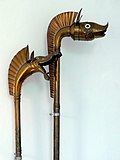 German reconstructions
 -
 French reconstruction


In popular culture
The carnyx is featured in the opening battle scene of the 2000 film Gladiator, and is used as a musical instrument in the soundtrack of its 2024 sequel Gladiator II.[29] It appears in several battle scenes of the French film, Druids (2001).[citation needed] A carnyx appears near the beginning of the 2012 Pixar computer-animated film Brave.[citation needed] The carnyx is used in the Gallic soundtrack in Sid Meier's Civilization VI.[citation needed] The bard Cacofonix from the Asterix series is often pictured carrying or occasionally blowing a carnyx.
See also
- Dord (musical instrument), another type of Celtic trumpet that has been revived
- Lur
- Dacian Draco
- Draco (military standard)
- Kabura-ya
- Lituus
Notes
- ^ Polybius. The Histories 2.29
- ^ Delmarre, 1987, pp. 106–107
- ^ "Geiriadur Prifysgol Cymru".
- ^ Garrow, Duncan (1 October 2008). Rethinking Celtic Art. Oxbow Books. p. 65. ISBN 978-1-84217-318-3.
- ^ Megaw, J. V. S. (1970). Art of the European Iron Age: A Study of the Elusive Image. Adams & Dart. p. 177. ISBN 978-0-239-00019-4.
- ^ Administrator. "The Carnyx from Tintignac". www.emaproject.eu. Retrieved 9 May 2022.
- ^ "Press report". Archived from the original on 1 September 2012. Retrieved 20 August 2013.
- ^ UPI.com Carnyx identified in Italy
- ^ a b Piggott, Stuart (April 1959). "The Carnyx in Early Iron Age Britain". The Antiquaries Journal. 39 (1–2): 19–32. doi:10.1017/S0003581500083591. ISSN 0003-5815.
- ^ Stocker, David; Everson, Paul (2005). Carver, Martin (ed.). The cross goes north: processes of conversion in northern Europe, AD 300 - 1300. Woodbridge, Suffolk: Boydell & Brewer. p. 277. ISBN 9781843831259.
- ^ NJ56 Banffshire (Map). 1:25,000. Chessington: Ordnance Survey. 1957.
Brazen swine's head found
- ^ Hunter
- ^ "Internet Archaeol 2. Dungworth. Home Page". April 1997.
- ^ "Deskford carnyx". National Museums Scotland. Archived from the original on 19 January 2021. Retrieved 8 December 2023.
- ^ Roberts, Alice (7 January 2026). Digging for Britain (Television production). BBC. Event occurs at 3:36. Retrieved 11 January 2026.
- ^ Prickett, Katy. "Rare Iron Age war trumpet and boar standard found". bbc.co.uk. BBC. Retrieved 9 January 2026.
- ^ Addley, Esther (7 January 2026). "'Extraordinary' iron age war trumpet find in Britain may have Boudicca links". The Guardian. p. 3.
- ^ The Numismatic Chronicle, and Journal of the Numismatic Society. Tayor & Walton. 1865. p. 11.
- ^ Kinnee, Lauren (12 March 2018). The Greek and Roman Trophy: From Battlefield Marker to Icon of Power. Routledge. ISBN 978-1-351-84657-8.
- ^ Pârvan, Vasile (1928). Dacia: An Outline of the Early Civilizations of the Carpatho-Danubian Countries. CUP Archive.
- ^ Penner, Todd C.; Stichele, Caroline Vander (2007). Mapping Gender in Ancient Religious Discourses. BRILL. ISBN 978-90-04-15447-6.
- ^ Celtic Culture: A-Celti. ABC-CLIO. 2006. p. 345. ISBN 978-1-85109-440-0.
- ^ "Rare Bardwell Iron Age trumpet sells for more than £4k". BBC News. 3 December 2021. Retrieved 7 February 2023.
- ^ Diodorus Siculus, Histories: 5.30
- ^ "Details - Sound Scotland".
- ^ "Details - Sound Scotland".
- ^ "Details - Lancashire County Council".
- ^ Leston, Ryan. "Why a huge horn was played before Wales v Iceland". bbc.co.uk. BBC. Retrieved 9 January 2026.
- ^ Beek, Michael (16 November 2024). "The ancient and unusual musical sounds at the heart of Gladiator II". BBC Music Magazine. Retrieved 9 November 2025.
References
- Delmarre, Xavier (2003) Dictionnaire de la langue gauloise (2nd ed.) Paris: Editions Errance. ISBN 2-87772-237-6
- Hunter, Fraser (of Museum of Scotland), Carnyx and Co- piece by Hunter on the carnyx
External links
- Ancient Celtic music in the Citizendium
- Carnyx and co. Carnyx music.
- Tintignac discoveries (in French, with photos)
- Carnyx on a gold stater of Caesar and on a silver denarius, both from 48 BC
- Rare Bardwell Iron Age trumpet sells for more than £4k


