








Nose cone design

Because of the problem of the aerodynamic design of the nose cone section of any vehicle or body meant to travel through a compressible fluid medium (such as a rocket or aircraft, missile, shell or bullet), an important problem is the determination of the nose cone geometrical shape for optimum performance. For many applications, such a task requires the definition of a solid of revolution shape that experiences minimal resistance to rapid motion through such a fluid medium.
Nose cone shapes and equations
General dimensions
In all of the following nose cone shape equations, L is the overall length of the nose cone and R is the radius of the base of the nose cone. y is the radius at any point x, as x varies from 0, at the tip of the nose cone, to L. The equations define the two-dimensional profile of the nose shape. The full body of revolution of the nose cone is formed by rotating the profile around the centerline C⁄L. While the equations describe the "perfect" shape, practical nose cones are often blunted or truncated for manufacturing, aerodynamic, or thermodynamic reasons.[1][2]
Conic


Spherically blunted conic


Bi-conic


Tangent ogive


Spherically blunted tangent ogive


Secant ogive


For a chosen ogive radius ρ greater than or equal to the ogive radius of a tangent ogive with the same R and L:


_Render.png)
A smaller ogive radius can be chosen; for , you will get the shape shown on the right, where the ogive has a "bulge" on top, i.e. it has more than one x that results in some values of y.

Elliptical


Parabolic
A parabolic series nosecone is defined by where and is a series-specific constant.[3]


_Nose_Cone_Render.png)
_Nose_Cone_Render.png)
_Nose_Cone_Render.png)
For ,

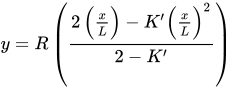
K′ can vary anywhere between 0 and 1, but the most common values used for nose cone shapes are:
| Parabola type | K′ value |
|---|---|
| Cone | 0 |
| Half | 1/2 |
| Three quarter | 3/4 |
| Full | 1 |
Power series
A power series nosecone is defined by where . will generate a concave geometry, while will generate a convex (or "flared") shape.[3]


 |
Half (n = 1/2) Three-quarter (n = 3/4) |
_Nose_Cone_Render.png)
_Nose_Cone_Render.png)
- For :


Common values of n include:
| Power type | n value |
|---|---|
| Cylinder | 0 |
| Half (parabola) | 1/2 |
| Three quarter | 3/4 |
| Cone | 1 |
Haack series
 |
LD-Haack (Von Kármán) (C = 0) LV-Haack (C = 1/3) |
_Nose_Cone_Render.png)

A Haack series nosecone is defined by:[3] where

- r is the radius divided by the maximum radius at a given θ or x,
- x is the distance from the nose divided by the total nose length.
Parametric formulation can be obtained by solving the θ formula for x (here, x is now distance from the nose, separated from the total nose length L, and y is the radius).

Special values of C (as described above) include:
| Haack series type | C value |
|---|---|
| LD-Haack (Von Kármán) | 0 |
| LV-Haack | 1/3 |
| Tangent | 2/3 |
Von Kármán ogive
The LD-Haack ogive is a special case of the Haack series with minimal drag for a given length and diameter, and is defined as a Haack series with C = 0, commonly called the Von Kármán or Von Kármán ogive. An ogive with minimal drag for a given length and volume can be called an LV-Haack series, defined by .[3] However, the LV-Haack series produces different values for radius as a function of x as opposed to the Sears-Haack body, which also attempts to provide a shape with minimal drag for a given length and volume. For example, the LV-Haack value for radius relative to maximum radius at x=0.5 is ≈ 0.7785, while a Sears-Haack body at the same point (halfway along the nose, which is 25% of the way along the body) has a radius relative to maximum radius of ≈ 0.8059.

Aerospike

An aerospike can be used to reduce the forebody pressure acting on supersonic aircraft. The aerospike creates a detached shock ahead of the body, thus reducing the drag acting on the aircraft.
Nose cone drag characteristics
Influence of the general shape


See also
Further reading
- Haack, Wolfgang (1941). "Geschoßformen kleinsten Wellenwiderstandes" (PDF). Bericht 139 der Lilienthal-Gesellschaft für Luftfahrtforschung: 14–28. Archived from the original (PDF) on 2007-09-27.
- U.S. Army Missile Command (17 July 1990). Design of Aerodynamically Stabilized Free Rockets. U.S. Government Printing Office. MIL-HDBK-762(MI).
References
- ^ Crowell Sr., Gary A. (1996). The Descriptive Geometry of Nose Cones (PDF) (Report). Archived from the original (PDF) on 11 April 2011. Retrieved 11 April 2011.
- ^ satyajit panigrahy (August 2020). "Improvement of Fire Power of Weapon System by Optimizing Nose Cone Shape and War Head Grouping". ResearchGate. doi:10.13140/RG.2.2.28694.36161.
- ^ a b c d Stoney, William E. (February 5, 1954). "TRANSONIC DRAG MEASUREMENTS OF EIGHT BODY-NOSE SHAPES" (PDF). Naca Research Memorandum. NACA-RM-L53K17 – via NASA Technical Reports Server.