









Abhinandananatha
| Abhinandananatha | |
|---|---|
4th Jain Tirthankara | |
 4th Tirthankar of Jainism in the present half time cycle | |
| Other names | Abhinandana Swami |
| Venerated in | Jainism |
| Predecessor | Sambhavanatha |
| Successor | Sumatinatha |
| Symbol | Monkey |
| Height | 350 dhanusha (1,050 meters) |
| Age | 5,000,000 purva (352.80 Quintillion Years) |
| Color | Golden |
| Genealogy | |
| Born | |
| Died | |
| Parents |
|
| Dynasty | Ikṣvākuvaṁśa |
| Part of a series on |
| Jainism |
|---|
 |

Abhinandananatha or Abhinandana Swami was the fourth Tirthankara of the present age (Avasarpini). He is said to have lived for 50 lakh purva. He was born to King Sanvara and Queen Siddhartha at Ayodhya in the Ikshvaku clan. His birth date was the second day of the Magh shukla month of the Indian calendar. According to Jain beliefs, he became a siddha, a liberated soul which has destroyed all of its Karma.
Life
Abhinandananatha or Abhinandana Swami was the fourth Tirthankara of the present age (Avasarpini).[1] He is said to have lived for 50 lakh purva.[2] He was born to King Samvara and Queen Siddhartha at Ayodhya in the Ikshvaku clan.[3] His birth date was the second day of the Magh shukla month of the Indian calendar.[1] He attained Kevala Jnana under priyangu tree.[4] According to Jain beliefs, he became a siddha, a liberated soul which has destroyed all of its Karma.[citation needed] According to Jain tradition, his height was 350 dhanusha (1,050 meters).[5][6] He is said to have lived for 5,000,000 purva.[6]
Abhinandananatha is said to have been born 10 lakh crore sagara after his predecessor, Sambhavanatha.[6] His successor, Sumatinatha, is said to have been born 9 lakh crore sagara after him.[6]
Adoration
Svayambhustotra by Jain monk, Acarya Samantabhadra is the adoration of twenty-four tirthankaras. Its five shlokas (aphorisms) adore the qualities of Abhinandananātha.[7] One such shloka is:
By constantly feeding the body to subdue inflictions like hunger, and by indulging in transient pleasures of the senses, neither the body nor the soul remains unscathed. Such deeds thus benefit neither the body nor the soul; O Lord Abhinandananātha, you had thus expounded the true nature of reality.[8]
Abhinandananatha is associated with Ape emblem, Piyala tree, Yakshesvara and Nayaka Yaksha, and Vajrasrinkala and Kalika Yakshi.[9]
Main temples
- Chaturmukha Basadi, Gerusoppa
- Abhinandanoday Teerth Kshetra, Lalitpur [U.P.]
-
 Chaturmukha Basadi, Gerusoppa
 -
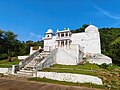 Abhinandananatha temple, Golakot
 -
 Abhinandanoday Teerth Kshetra, Lalitpur
.jpg)
.jpg)
.jpg)
See also
References
Citations
- ^ a b Tukol 1980, p. 31.
- ^ Vijay K. Jain 2015, p. 185.
- ^ Vijay K. Jain 2015, p. 184.
- ^ Krishna & Amirthalingam 2014, p. 46.
- ^ Vijay K. Jain 2015, p. 184-185.
- ^ a b c d Finegan 1952, p. 190.
- ^ Vijay K. Jain 2015, p. 22-24.
- ^ Vijay K. Jain 2015, p. 24.
- ^ Tandon 2002, p. 44.
Sources
- Finegan, Jack (1952), The archeology of world religions, Princeton University Press
- Johnson, Helen M. (1931), Abhinandanacaritra (Book 3.2 of the Trishashti Shalaka Purusha Caritra), Baroda Oriental Institute
- Jain, Vijay K. (2015), Acarya Samantabhadra's Svayambhustotra: Adoration of The Twenty-four Tirthankara, Vikalp Printers, ISBN 978-81-903639-7-6, archived from the original on 16 September 2015,
 This article incorporates text from this source, which is in the public domain.
 - Krishna, Nanditha; Amirthalingam, M. (2014) [2013], Sacred Plants of India, Penguin Books, ISBN 978-9-351-18691-5
- Tandon, Om Prakash (2002) [1968], Jaina Shrines in India (1 ed.), New Delhi: Publications Division, Ministry of Information and Broadcasting, Government of India, ISBN 81-230-1013-3
- Tukol, T. K. (1980), Compendium of Jainism, Dharwad: University of Karnataka
| Gods | |||||
|---|---|---|---|---|---|
| Philosophy | |||||
| Branches |
| ||||
| Practices | |||||
| Literature | |||||
| Symbols | |||||
| Ascetics | |||||
| Scholars | |||||
| Community |
| ||||
| Jainism in |
| ||||
| Jainism and | |||||
| Dynasties and empires | |||||
| Related | |||||
| Lists | |||||
| Navboxes | |||||
